
A slim wall in Rosebank that had to work harder
This project came from a private apartment client in Rosebank, Johannesburg, who wanted a feature wall for a living area with very little spare width. The wall sat close to a passage opening and opposite windows, so anything too glossy would have thrown off reflections in the afternoon. The brief was to turn a personal image set into something that felt gallery-like but still practical for everyday living.
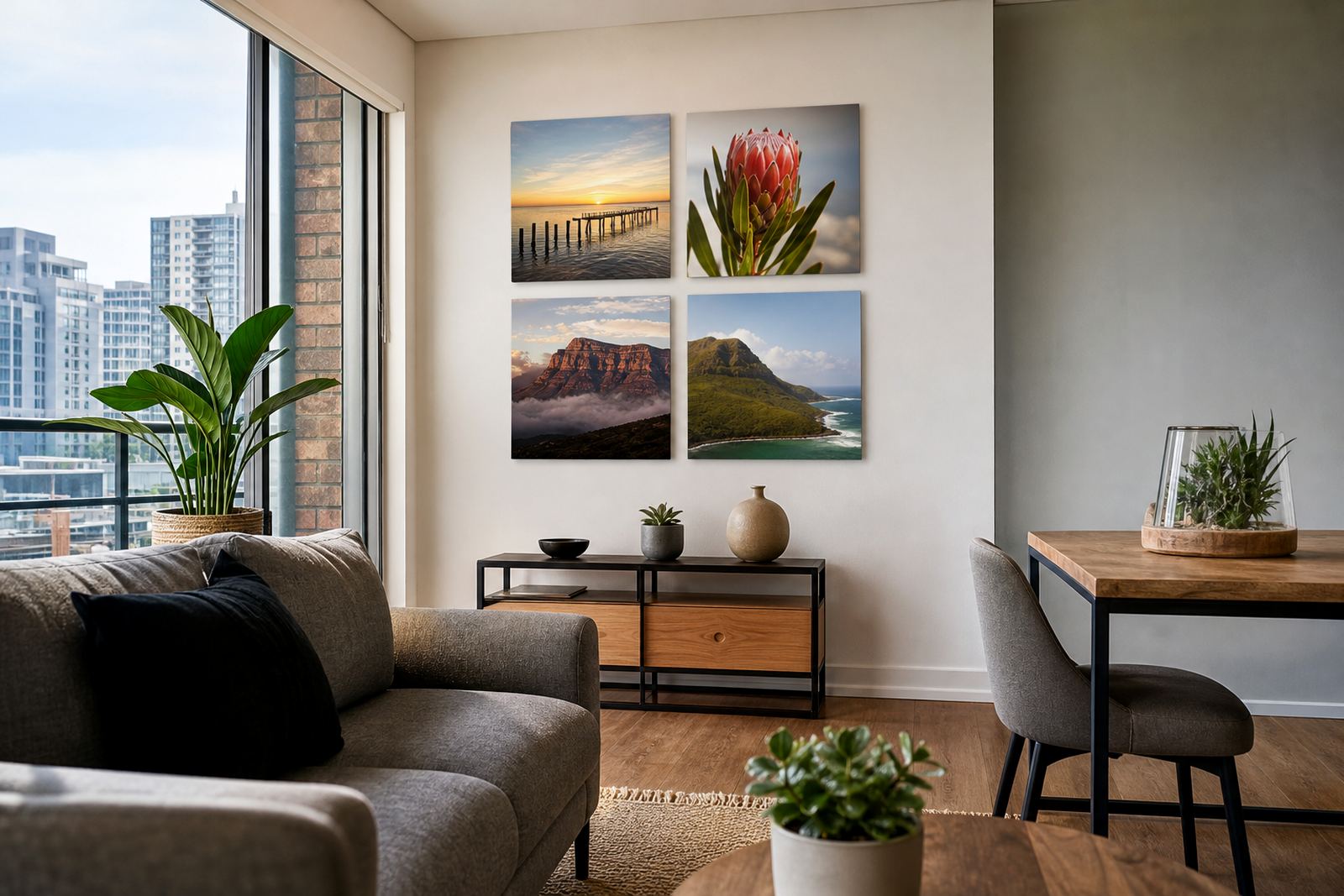
The client supplied a small collection of high-resolution files and asked for advice on which image would hold up best as a four-panel grid. We reviewed each file for cropping, edge placement and tonal balance, then helped narrow the layout to one strong photograph split across four aluminium panels. That let the image breathe on a tight wall without the room feeling busy.
Rosebank apartments often have mixed light, bright by day and then warm at night once the curtains are drawn. That makes finish choice important, because a panel that looks sharp in the morning can catch too much glare after sunset. We kept the layout simple, with even spacing and a neat outer edge, so the wall reads cleanly from the lounge and from the dining side too.
How we handled the image before it touched aluminium
The work started with file checks, resolution review and crop planning. For a four-panel layout, the centre line and panel joins matter more than people expect, because any small shift becomes obvious once the pieces are hung. We checked the image at full size, marked safe areas for faces and focal points, then planned the cut lines so the composition would still make sense across all four sections.
We also prepared the colour for dye sublimation onto coated aluminium. That process needs the file to be handled carefully so skin tones, shadows and strong accent colours stay controlled after heat transfer. In a compact apartment setting the wrong contrast can look harsh, so we kept the blacks balanced and softened the brightest highlights a bit rather than let them dominate the wall.
- File review for resolution and sharpness
- Crop planning for a four-panel grid
- Colour preparation for coated aluminium
- Test layout approval before production
- Finish selection based on room light
Because the client intended to keep the piece long term, we also reminded them that they must own the image rights or have permission to use the files they send. That keeps the order clean and avoids any issues later on.
Four panels, one measured rhythm
The final build was a set of four custom-sized aluminium photo panels arranged as a horizontal grid. Each panel was cut to suit the wall proportions, with consistent gaps between the sections so the full composition lands neatly in the room. The image was printed onto coated aluminium using dye sublimation, which gives a crisp finish and good colour depth without adding bulk to the wall.
The client chose a matte surface for this apartment because it sat better with the natural light and nearby window glare. Matte also works well in smaller interiors, since it keeps attention on the image rather than reflections. For clients wanting stronger colour pop, gloss is still an option, while white aluminium suits full-colour images and brushed aluminium works best where a softer metallic character is wanted.
- Four-panel wall grid
- Custom sizing to suit a narrow apartment wall
- Matte finish selected for low glare
- Coated aluminium substrate for print stability
- Hanging hardware supplied for secure mounting
We supplied the hanging hardware in a generic concealed style suited to apartment walls, along with spacing guidance for the installer. In a place like Rosebank, where some buildings have stricter wall-fixing rules, that kind of planning saves time and avoids unnecessary holes.
Production notes from Randburg to Rosebank
Our Randburg base handled the full production, packing and dispatch. The turnaround took just over two weeks from the first file review to delivery, with the main time spent on proofing, panel preparation and finishing. That gave us space to confirm the crop alignment and make sure the panel edges were neat and consistent.
The apartment itself had a narrow approach for delivery, so the packing had to be solid but easy to carry. We wrapped each panel individually, marked the sequence clearly and protected the corners so the surfaces would arrive clean. Johannesburg traffic can stretch a short trip into a longer one, so delivery timing matters almost as much as the packing. We planned the handover for a quieter window and kept the order compact enough for easy transport.
The result was a wall piece that fitted the room instead of overpowering it. The grid adds structure, while the image still carries enough presence to anchor the lounge. The client wanted something personal without visual clutter, and that balance is what the four-panel format handled best.
Why the apartment wall felt bigger after the install
Once the panels were up, the wall gained definition without needing any extra decor around it. The breaks between the sections introduced a measured rhythm, which helped the narrow wall feel more intentional and less boxed in. Because the piece was sized to the room, it did not overpower the furniture or fight with the ceiling height.
For apartment projects we often find that good results come from restraint rather than adding more material. One image, split well, can do more than several smaller items crowded together. The aluminium surface also keeps the panel light compared with framed glass, which is useful for urban homes where wall strength and fixing points can vary.
- Sharper wall presence without crowding the room
- Better balance between light, image and furniture
- Cleaner look than multiple framed pieces
- Lightweight construction suited to apartment mounting
In this case the photograph carried the memory, while the panel build gave it the finish it needed. It is a practical format for living rooms, passages and office reception areas where the wall needs a strong point of focus but not a heavy frame system.
What worked well
If we were doing this again for another compact apartment, we would use the same process: tight file checks, a mock-up of the four-panel spacing and a finish test matched to the room light. That approach works well when the wall is narrow and the interior has shifting daylight through the day.
We would also keep the same priority order. First, make sure the image has enough resolution for the final size. Second, confirm the crop before printing. Third, choose the finish based on the room rather than just on the image itself. Those three steps save a lot of rework and keep the final result clean.
For clients across Johannesburg, Cape Town, Durban, Pretoria and Gqeberha, this kind of project shows how a small wall can still carry a proper visual statement. It just needs the right proportions, the right surface and a bit of planning before print. The Rosebank apartment was a good reminder that compact spaces can still hold strong imagery when the panels are handled properly.
Key facts
| Project | Rosebank Apartment |
|---|---|
| Client type | Private apartment client |
| Location | Rosebank, Johannesburg |
| Format | Four-panel aluminium photo grid |
| Finish | Matte coated aluminium |
| Turnaround | Just over 2 weeks |